
Home›What We Treat›Core and Ab Separation
Pelvic health for women
Core and ab separation treatment in Shirley, MA
The short answer
Ab separation, called diastasis recti, happens when the two sides of the belly muscles stretch apart, most often to make room for a growing baby. For many women the gap narrows on its own after delivery, but some are left with a bulge, a weak core, back pain or leaks. The right core and breathing work helps most women get their strength and confidence back, without needing surgery.
On this page
What usually causes ab separation
Some separation during pregnancy is normal and expected. It is how your body makes room for baby. These are the things that make it more likely to linger.
- Pregnancy
- The belly muscles and the tissue between them stretch as baby grows, especially late in pregnancy.
- More than one pregnancy, or twins
- More stretching, or less time to recover between babies, makes a lasting gap more common.
- How you handle pressure
- Holding your breath and straining when you lift, cough or go to the bathroom pushes out on the middle of your belly.
- Going back to hard ab work too soon
- Heavy crunches or planks before the core is ready can make the bulge worse.
- A core and pelvic floor that are not working together
- The deep belly muscles, breathing muscle and pelvic floor are a team. When one is off, the middle of your belly takes more of the load.
When to get it checked
Get checked if you notice a ridge or dome down the middle of your belly when you sit up, if your core feels weak months after having a baby, or if you have back pain, leaks or pelvic heaviness along with it. Go to a doctor or the emergency room right away if a bulge in your belly becomes hard, very painful or will not go back in, especially with nausea or vomiting, or if a c-section scar becomes red, hot, swollen or starts to drain.
What you can do at home right now
These are safe starting points for most people. They are not a replacement for a proper evaluation.
- Breathe out on effort
- Exhale as you stand up, lift or push. It helps the deep core work instead of pushing out on the belly.
- Roll to get up
- Roll onto your side to get out of bed or up off the floor instead of doing a sit up motion.
- Hold off on crunches for now
- Gentle breathing and deep core work are a better starting point until you know how your core is doing.
How we treat ab separation at Whole Health Solutions
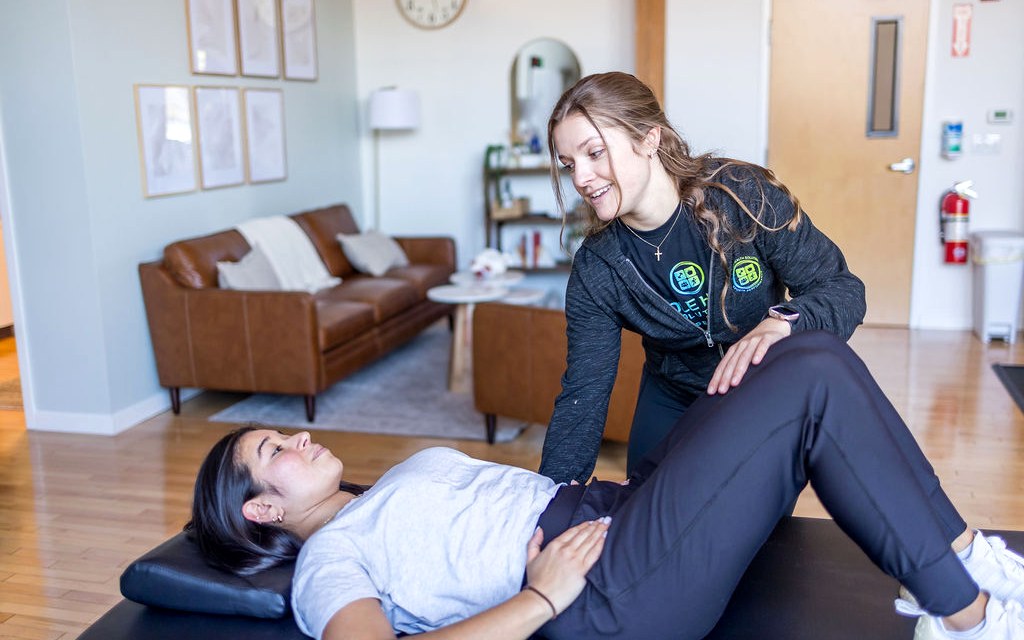
Your pelvic health therapist is with you for the whole appointment, start to finish, in a private room. We check the gap and, more importantly, how well your core, breathing and pelvic floor are working together, then build a plan around your body and your goals.
01
Relieve
Ease back pain and pressure with better breathing, posture and ways of lifting and carrying your baby.
02
Rebuild
Deep core and pelvic floor training that builds from the inside out, then more challenging strength work as you are ready.
03
Perform
Back to running, lifting and the workouts you love with a strong, supported core. When you are ready, our personal trainers keep you progressing.
04
Thrive
Stay strong through every season of life, from pregnancy to menopause and beyond, with a team that already knows your story.
Thrive is not a finish line. When life brings something new, the loop starts again with the same team.
Common exercises for core and ab separation
These are a few of the exercises our team often uses for core and ab separation. Tap one to watch.
Please read first. These are not right for everyone. If a move brings on sharp pain, numbness or tingling, stop and talk to one of our pelvic health therapists before you keep going.
Learn from our team
Short, free videos from our clinicians on questions we hear about core and ab separation all the time.
Read more from our team
Blog posts and newsletter tips from our clinicians that go with core and ab separation.
Talk to a pelvic health therapist
A free call to tell us what is going on and see if we are the right fit.
Common questions about core and ab separation
Can diastasis recti heal on its own?
Often, yes. Many women see the gap narrow in the first few months after delivery. If it has not, or your core still feels weak, the right exercise plan helps even years later.
What exercises should I avoid with ab separation?
Early on, it is usually best to go easy on crunches, sit ups and any move that makes your belly dome or bulge. That does not mean avoiding them forever. A pelvic health therapist can show you when and how to add them back.
Do I need surgery for diastasis recti?
Most women do not. Surgery is usually only considered when there is a hernia or a lot of weakness that has not improved with a good rehab plan. We will tell you if we think you should see a surgeon.
Do I need a referral for ab separation?
No. You can book directly with us. Most of our clients do use their insurance for reimbursement of our physical therapy services. We go over everything in the discovery meeting.
This page is general information, not a diagnosis. Everyone is different, so the best next step is an evaluation with one of our pelvic health therapists.
Visit us
Serving 22+ nearby towns and beyond
2 Shaker Road, Suite C200, Shirley, MA 01464. Monday to Thursday, 5:00 am to 8:00 pm, Friday, 5:00 am to 3:00 pm, and Saturday, 6:00 am to 1:00 pm.