
Home›What We Treat›Achilles Pain
Foot and ankle
Achilles pain treatment in Shirley, MA
The short answer
Most Achilles pain is tendinopathy, which means the tendon has been asked to do more than it was ready for. A jump in running or walking, more hills, tight or weak calves, or a change in shoes are the usual reasons. The tendon responds very well to the right strength program, and shockwave therapy helps many stubborn cases.
On this page
What usually causes Achilles pain
The Achilles is the strongest tendon in the body, but it still gets cranky when the load goes up too fast.
- Too much, too soon
- More miles, more hills, speed work, jumping sports or a new job on your feet can overload the tendon.
- Weak calves
- When the calf muscles cannot handle the load, the tendon takes more of it with every step.
- Pain in the middle of the tendon
- A sore, thickened spot a couple of inches above the heel, stiff in the morning and at the start of activity.
- Pain where it attaches to the heel
- Pain right at the back of the heel, often worse with shoes that press on it or with uphill walking.
- Changes in shoes
- Switching to flatter or more minimal shoes, or wearing worn out ones, can set it off.
When to get it checked
Get your Achilles looked at if it has been sore for more than a couple of weeks, if it is stiff every morning, or if it is getting worse with activity. See a doctor right away if you feel a sudden pop or a feeling like someone kicked you in the back of the leg, if you cannot push off or rise up on your toes, or if there is a gap in the tendon, since these can be signs of a rupture. Also call your doctor if Achilles pain starts after taking a new antibiotic, or if the area is red, hot and swollen.
What you can do at home right now
These are safe starting points for most people. They are not a replacement for a proper evaluation.
- Calm the load, keep moving
- Cut back on running, hills and jumping for now, but keep walking in amounts that feel okay. Complete rest weakens the tendon.
- Start calf raises
- Slow calf raises on flat ground, with mild discomfort at most, are one of the best things you can do for a sore Achilles.
- Check your shoes
- A shoe with a bit of heel can ease the load for now. Avoid shoes that rub or press on the back of the heel.
How we treat Achilles pain at Whole Health Solutions
Your physical therapist is with you for the whole appointment, start to finish. We look at the tendon, your calf strength, how you walk or run, and your training, then build a plan around your life and your goals.
01
Relieve
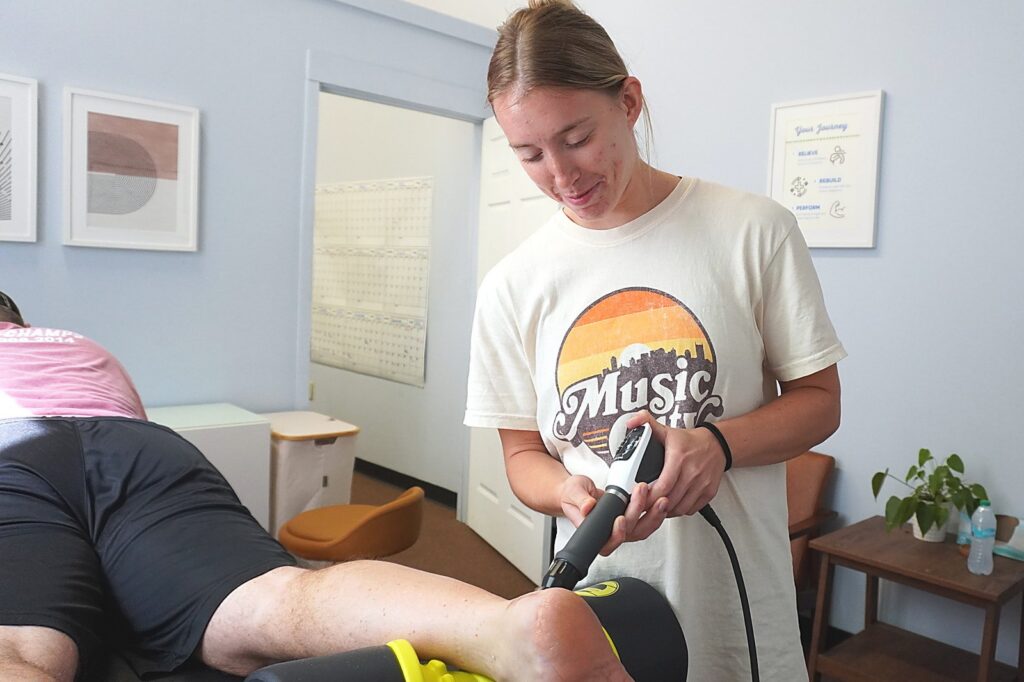
Shockwave therapy and dry needling when they fit, hands on care, and changes to your activity so the tendon calms down.
02
Rebuild
A progressive calf and tendon strength program, the most proven way to get an Achilles strong again, plus strength for the hips and feet.
03
Perform
A step by step return to running, jumping and your sport, with a plan so it does not come back. When you are ready, our athletic performance coaches and personal trainers keep you going.
04
Thrive
Stay with the team that knows you. Check ins, training and a quick tune up whenever something new comes up, so this stays in the past.
Thrive is not a finish line. When life brings something new, the loop starts again with the same team.
How dry needling and shockwave therapy can help
For Achilles pain, your physical therapist may use dry needling and shockwave therapy to speed things up. They will tell you on your first visit if it is a good fit.
Dry needling
A very thin needle placed into a tight, guarded muscle helps it let go, so pain calms down and you can move and strengthen again. Always paired with hands on care and strength work.
Learn about dry needlingShockwave therapy
Sound waves delivered to a stubborn tendon or tissue help restart healing when it has stalled for months. Always paired with the strength work that keeps it from coming back.
Learn about shockwave therapyCommon exercises for Achilles pain
These are a few of the exercises our team often uses for Achilles pain. Tap one to watch.
Please read first. These are not right for everyone. If a move brings on sharp pain, numbness or tingling, stop and talk to one of our physical therapists before you keep going.
Learn from our team
Short, free videos from our clinicians on questions we hear about Achilles pain all the time.
Read more from our team
Blog posts, newsletter tips and columns from our clinicians that go with Achilles pain.
Talk to a physical therapist
A free call to tell us what is going on and see if we are the right fit.
Common questions about Achilles pain
Should I stretch a sore Achilles?
Gentle calf stretching is fine for many people, but strength work matters more. If the pain is right where the tendon meets the heel, deep stretches over a step can make it worse.
Can I keep running with Achilles pain?
Often yes, at a lower level. If the pain stays mild during the run and is not worse the next morning, you can usually keep going while you build strength.
How long does Achilles tendinitis take to heal?
Tendons adapt slowly, so it often takes a few months of steady strength work. Most people notice improvement well before that.
Do I need a referral for Achilles pain?
No. You can book directly with us. Most of our clients do use their insurance for reimbursement of our physical therapy services. We go over everything in the discovery meeting.
This page is general information, not a diagnosis. Everyone is different, so the best next step is an evaluation with one of our physical therapists.
Visit us
Serving 22+ nearby towns and beyond
2 Shaker Road, Suite C200, Shirley, MA 01464. Monday to Thursday, 5:00 am to 8:00 pm, Friday, 5:00 am to 3:00 pm, and Saturday, 6:00 am to 1:00 pm.